HTTP and hosters
ChecksumsReal-Debrid140 XFS sitesMetalink
Bundled resolvers for cloud drives, filehosters and multihosters such as Google Drive, MEGA and Real-Debrid, with fallback between hosters.
More in the wiki ↗Features
Collect from any source, review in the LinkGrabber, control one persistent queue, and let the pipeline finish the job.
01 — Source coverage
Different sources, one way of working: the same packages, priorities, controls, destinations and recovery for all of them.
Bundled resolvers for cloud drives, filehosters and multihosters such as Google Drive, MEGA and Real-Debrid, with fallback between hosters.
More in the wiki ↗Media, gallery, and livestream features use separately available external tools. Source compatibility depends on those tools and the source website.
02 — LinkGrabber
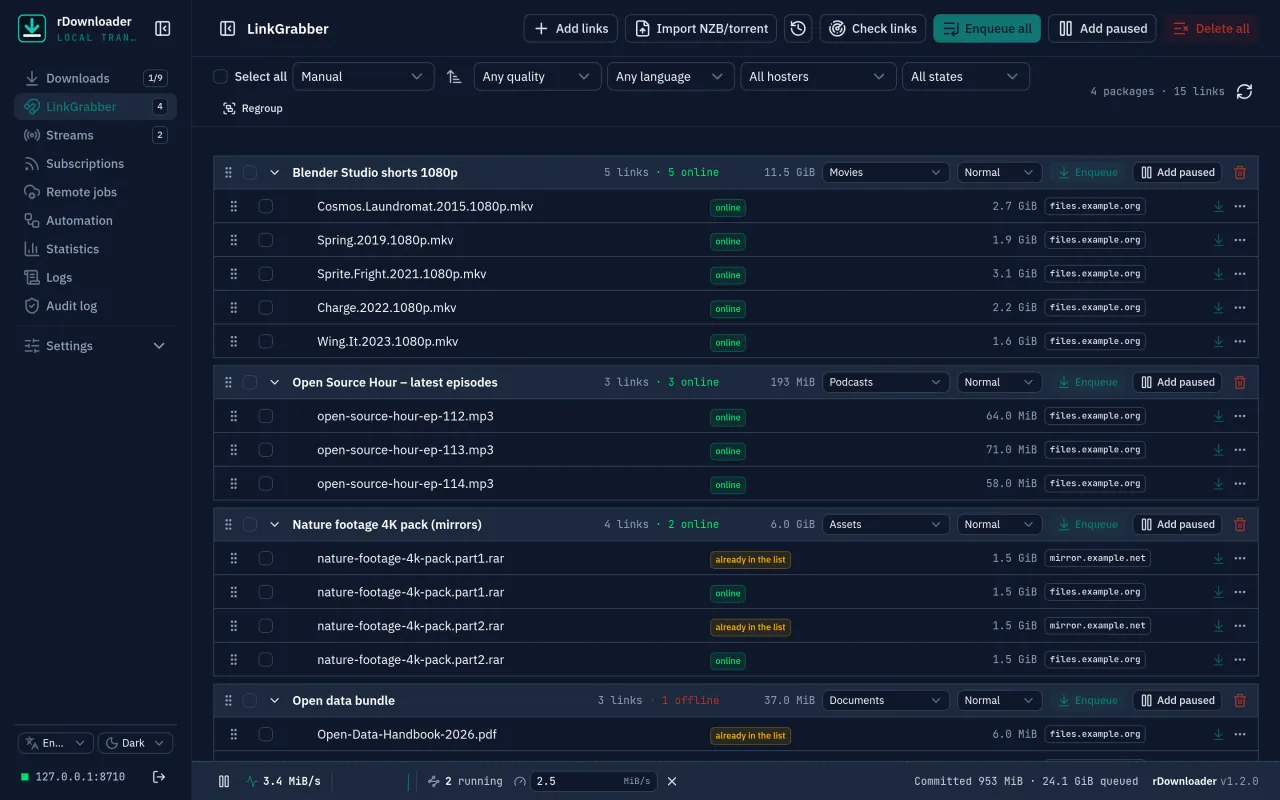
Paste links, capture them in the browser, drop an NZB or torrent, or search your indexers. The LinkGrabber checks and groups them; you decide what gets queued.
CHECK
See online status, size, provider and duplicates, including links you already downloaded, before anything starts.
ORGANIZE
Group links into packages with category, priority and password. A release at several hosters is one row, and filter rules sort new links as they arrive.
CAPTURE
Extension, clipboard, Click'n'Load, containers, feeds, API and MCP all lead into one review. Site rules show a release page's files before anything is fetched.
LinkGrabber
Persistent queue
03 — Automation pipeline
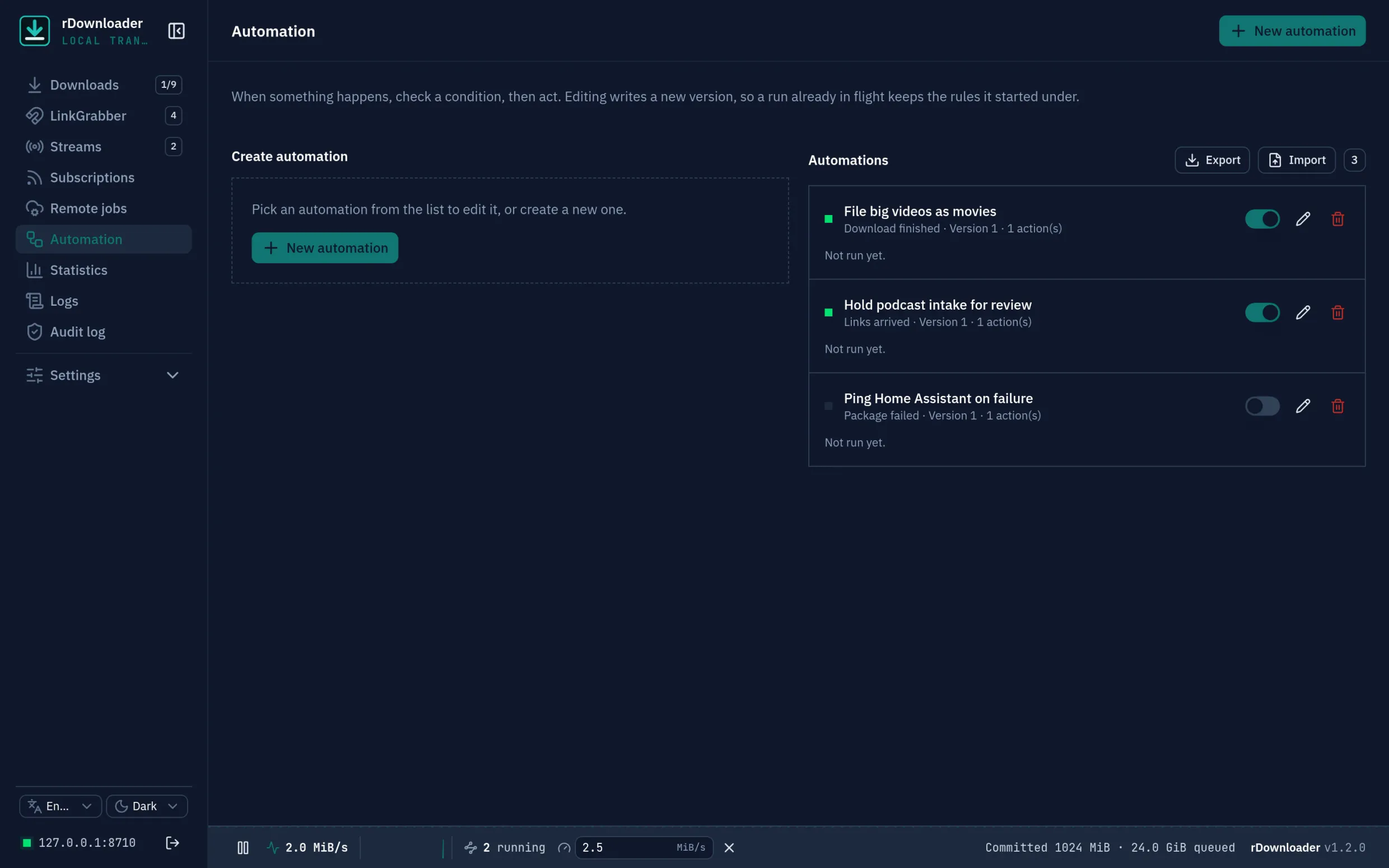
Route packages with categories and rules, or build event-driven workflows. rDownloader then verifies, repairs, extracts, runs scripts, notifies and uploads.
Pick a level from no post-processing to repair, unpack and delete. Interrupted steps resume, and an incomplete package is never unpacked with gaps.
Trigger actions on events, storage thresholds or a schedule: set priorities, pause the queue, unpack, notify or add links. Every run is logged.
PAR2 repairs Usenet packages, SFV verifies any package, and an optional scan with your own ClamAV stops a package with a finding.
One clear rule for taken names: rename, skip, overwrite or ask. Categories sort series and films into folders by template.
04 — Queue control
Keep the overview when one link becomes hundreds of files: work per package or file, set priorities and bandwidth budgets, and pick up after a restart.
Queue and transfer states survive a restart, finished packages stay searchable in the history, and packages export and import as link files.
Run up to 32 downloads at once, split files into chunks and wait out hoster limits without wasting retries.
Set priorities and order, search and filter, and pause, resume or reset thousands of files in one step. A failed package starts over from scratch, its files cleared from disk.
Validate expected MD5, SHA-1, SHA-256, or CRC32 values and protect partial files against changed remote content.
Track speed globally and per package or file, recent throughput, remaining data, and free space.
Limit speed live, by schedule or per host, account, category or package, route traffic through proxies, and let downloads run only at night.
Hold downloads on a storage root that runs low and resume once there is room; pause new starts on battery or metered networks.
When the queue drains, run a script or shut down. Get notified by webhook, email, ntfy, Discord, Telegram or push, and refresh Plex, Jellyfin or Emby.